
- Home
- /
- Kidney Transplant Evaluation
Best Kidney Transplant Doctors in Raipur, Chhattisgarh

Dr. Karan Saraf
Nephrologist, Raipur
Specialty
Nephrology & Kidney Transplant
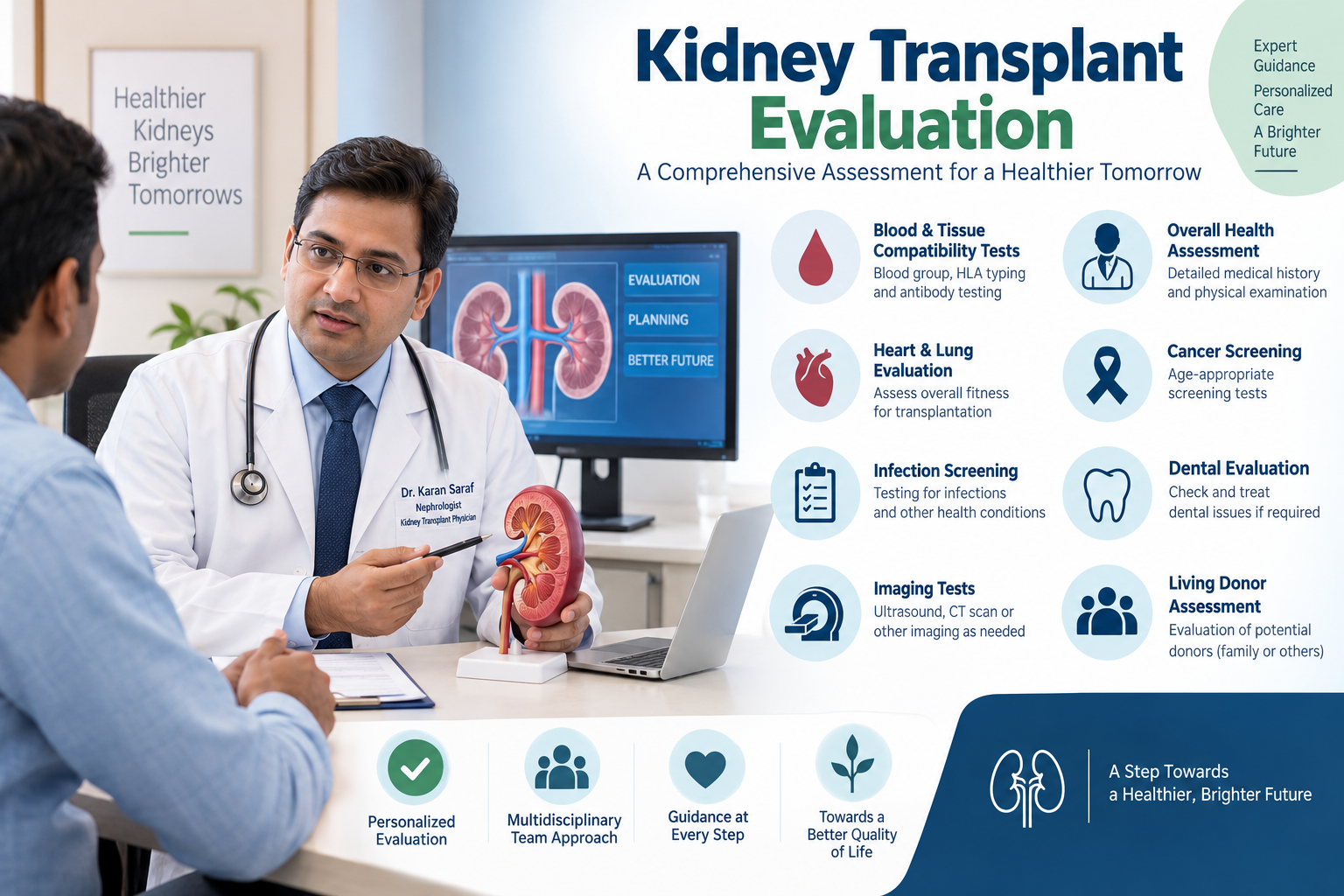
Kidney Transplant Evaluation
Kidney Transplant Evaluation in Raipur
A kidney transplant can be an important treatment option for people with advanced kidney disease or kidney failure. However, not every patient is suitable for transplant surgery. A detailed medical evaluation is needed before a transplant team can decide whether transplantation is an appropriate and safe option.
Kidney Transplant Evaluation in Raipur helps patients understand their current kidney condition, overall health, transplant eligibility, possible donor options, and the next steps in the transplant process.
Dr. Karan Saraf is a Senior Consultant Nephrologist and Kidney Transplant Physician who provides kidney transplant consultation and evaluation for patients with advanced kidney disease. The evaluation focuses on understanding the patient’s medical history, kidney function, other health conditions, medications, and overall readiness for transplant care.
Early evaluation can also provide more time to complete necessary tests, manage other health problems, and explore living-donor options where appropriate. You do not necessarily have to wait until dialysis has started before discussing transplantation with a kidney specialist.
- 15+ years in clinical nephrology
- Gold medalist, DM Nephrology
- Published researcher, national & international journals
- 100% kidney transplant success rate
About the Doctor
Meet Dr. Karan Saraf
Dr. Karan Saraf is a Senior Consultant Nephrologist and Kidney Transplant Physician with specialized expertise in kidney care. His focus is on understanding each patient’s condition and providing treatment based on their individual medical needs.
Kidney problems can be different for every person. Some patients may have an abnormal kidney test but no symptoms, while others may have swelling, changes in urination, high blood pressure, or reduced kidney function.
As an experienced Nephrologist in Raipur, Dr. Karan Saraf evaluates the patient’s medical history, symptoms, previous reports, medicines, and other health conditions before planning further care.
Patients looking for the Best Nephrologist in Raipur Chhattisgarh can receive personalized guidance for both new kidney concerns and existing kidney conditions requiring regular follow-up.
What Is Kidney Transplant Evaluation?
Kidney transplant evaluation is a detailed assessment carried out before a patient is considered for kidney transplantation.
The purpose is not simply to check kidney function. The transplant team needs to understand whether the patient is medically prepared for a major operation and long-term transplant care.
During a Kidney Transplant Assessment in Raipur, doctors may review:
- Current kidney function
- Cause and stage of kidney disease
- Dialysis history, if applicable
- Blood pressure and diabetes control
- Heart and lung health
- Previous surgeries and medical conditions
- Current medicines
- Infection history
- Blood group and tissue compatibility
- Potential living-donor information
- General physical health
- Ability to follow long-term treatment and medicines
- The exact tests required can differ from one patient to another and are decided by the transplant team.
Who May Need a Kidney Transplant Evaluation?
A kidney transplant discussion may be appropriate for people with advanced chronic kidney disease or kidney failure.
Patients may consider a Kidney Transplant Consultation in Raipur when kidney function has significantly declined or when dialysis is becoming necessary.
Some common situations include:
- Advanced chronic kidney disease
- Kidney failure
- Long-term dialysis
- Severely reduced kidney function
- Kidney disease caused by diabetes
- Kidney disease related to high blood pressure
- Certain inherited kidney conditions
- Progressive kidney disease despite medical treatment
Kidney transplantation is a treatment for kidney failure, but it is not a cure for the underlying condition. After transplantation, patients need regular medical follow-up and medicines to reduce the risk of rejection.
A nephrologist can help determine whether it is appropriate to begin the transplant evaluation process.

What Happens After Kidney Transplant Evaluation?
After the required tests are completed, the transplant team reviews the patient’s medical information.
There may be additional tests or treatment requirements before a final decision is made.
For example, a patient may first need treatment or better control of another health problem. The transplant team may also recommend lifestyle changes or additional investigations.
If the patient is considered suitable, the transplant center explains the next steps, which may include:
- Approval for transplantation
- Waitlist-related processes for deceased-donor transplantation
- Living-donor assessment
- Additional medical preparation
- Transplant planning
- Regular follow-up while waiting
The exact process varies by transplant center and by the patient’s medical condition.
Best Kidney Transplant Doctors in Raipur, Chhattisgarh
Patients searching for the Best Kidney Transplant Doctors in Raipur, Chhattisgarh should consider important factors such as nephrology experience, transplant-related expertise, detailed patient assessment, access to an appropriate transplant center, and long-term follow-up planning.
Dr. Karan Saraf is a Senior Consultant Nephrologist & Kidney Transplant Physician providing nephrology and kidney transplant consultation in Raipur.
A kidney transplant requires coordination between several healthcare professionals, including nephrologists, transplant surgeons, coordinators, pharmacists, dietitians, social workers, and other specialists when required.
The role of a nephrologist includes evaluating kidney function, discussing treatment options, managing medical conditions related to kidney failure, and helping patients understand whether transplant evaluation should be considered.
Importantly, transplant surgery itself is performed by the appropriate transplant surgical team at a qualified transplant center. Evaluation and consultation help patients understand the pathway and prepare for the next stage of care.
When Should You Consult a Kidney Transplant Specialist?
Consider discussing kidney transplantation with a Kidney Transplant Specialist in Raipur if you have:
- Advanced CKD
- Severe reduction in kidney function
- Kidney failure
- Long-term dialysis requirements
- Progressive kidney disease
- A possible living donor
- Questions about transplantation before dialysis
- Concerns about your future kidney treatment options
Early discussion can help you understand what needs to be done before transplantation and whether you should be referred to a transplant center.
Living Donor Kidney Transplant Evaluation
Some patients may have a family member, relative, spouse, or another suitable person who is willing to be evaluated as a living kidney donor.
In this situation, both the recipient and potential donor require careful evaluation.
A Kidney Transplant Doctor in Raipur can help patients understand the initial process and guide them toward the appropriate transplant center for detailed donor and recipient assessment.
Living-donor evaluation can include:
- Medical history
- Physical examination
- Blood tests
- Blood group testing
- Tissue typing
- Compatibility testing
- Kidney function assessment
- Urine testing
- Imaging
- Heart and lung assessment
- Infection screening
- Other tests based on individual circumstances
The potential donor must independently be assessed to make sure donation is medically appropriate.
If a potential donor is not a suitable match, patients may still be able to discuss options such as paired kidney exchange with the transplant center.
Kidney Transplant Evaluation for Dialysis Patients
Patients already receiving dialysis may also be evaluated for kidney transplantation.
Dialysis can help manage kidney failure, but transplantation may be considered as another treatment option for suitable patients.
During a Kidney Transplant Evaluation in Raipur, the doctor may review:
- Duration of dialysis
- Current kidney function
- Dialysis-related medical issues
- Blood pressure
- Diabetes
- Heart health
- Previous infections
- Previous surgeries
- Other medical conditions
- Potential donor availability
The transplant center will then complete its own detailed assessment before deciding whether the patient can proceed with transplantation.
Being on dialysis or undergoing evaluation does not automatically mean that a patient will be placed on a transplant waiting list. The transplant center makes that decision after completing its evaluation.
Why Choose Us
Why Choose Dr. Karan Saraf?
Choosing a kidney specialist is an important decision, particularly when a condition requires long-term monitoring.
Dr. Karan Saraf is a Senior Consultant Nephrologist and Kidney Transplant Physician providing specialized kidney care in Raipur.
Experienced Kidney Specialist
Dr. Karan Saraf has more than 10 years of experience in nephrology and kidney transplant medicine. His practice focuses on the evaluation and management of kidney-related conditions.
Personalized Care
Every patient has different medical needs. Treatment recommendations are made according to the patient's symptoms, reports, medical history, and overall health.
Comprehensive Kidney Care
Patients can receive guidance for kidney disease, chronic kidney conditions, hypertension-related kidney problems, dialysis care, and kidney transplant-related concerns.
Patient-Friendly Approach
Medical information can sometimes be difficult to understand. Clear communication helps patients understand their condition and participate in treatment decisions.
Frequently Asked Questions
Kidney Transplant Evaluation in Raipur is a detailed medical assessment for patients with advanced kidney disease or kidney failure who may be considering a kidney transplant. The evaluation looks at kidney function, overall health, heart and lung health, infections, blood and tissue compatibility, and other factors that can affect transplant suitability. The transplant center decides which tests are needed for each patient.
You can consult a Kidney Transplant Doctor in Raipur when your kidney function is severely reduced, you have advanced chronic kidney disease, or you are approaching or already receiving dialysis. It is not always necessary to wait until dialysis begins. Early evaluation can provide more time for medical preparation and assessment of a potential living donor.
When searching for the Best Kidney Transplant Doctors in Raipur, Chhattisgarh, patients should look at nephrology and transplant-care experience, the quality of medical evaluation, access to an appropriate transplant center, and the availability of follow-up care. A nephrologist can review your kidney condition and guide you about whether a formal transplant-center evaluation may be appropriate.
No, dialysis is not always required before transplantation. Some suitable patients may undergo a transplant before dialysis becomes necessary. This is known as a preemptive kidney transplant. Whether this is possible depends on kidney function, overall health, donor availability, and the transplant team's assessment.
A Kidney Transplant Assessment in Raipur may include blood group testing, HLA or tissue typing, antibody testing, kidney function tests, infection screening, ECG, heart evaluation, chest imaging, and other investigations. Cancer screening, dental evaluation, or vascular imaging may also be recommended depending on the patient's age, health, and transplant-center requirements.
Yes. A Kidney Specialist in Raipur can review your kidney disease, previous reports, medications, dialysis history, and other health conditions before you proceed to a transplant center. The nephrologist can also explain why transplant evaluation may be recommended and what information or medical records you may need for the next stage.
A family member may be evaluated as a living kidney donor if they are willing and medically suitable. The potential donor has a separate evaluation that can include medical history, physical examination, blood and urine tests, imaging, kidney-function assessment, and compatibility testing. The transplant team makes the final decision about donor suitability.
If a potential living donor is not a suitable match, you may still have other options. Depending on the transplant center and applicable programs, paired kidney donation may be considered. In this process, incompatible donor-recipient pairs may be matched with other pairs so that each recipient can receive a compatible kidney.
The time required for Kidney Transplant Evaluation varies from patient to patient. The process can involve several appointments, laboratory tests, imaging, specialist assessments, and additional investigations if needed. Starting early can give patients more time to complete these steps and address health issues that may need treatment before transplantation.
For a Kidney Transplant Consultation in Raipur, it is useful to bring recent blood and urine reports, kidney-function reports, previous hospital records, scan reports, dialysis records if applicable, and a list of your current medicines. Previous transplant-related reports or information about a potential living donor should also be shared with the doctor.